
A sea view, a premium residence address, and attractive rental potential can make an Istanbul property feel like an immediate opportunity. Yet for an international buyer, the first serious question should be structural: how to evaluate earthquake risk before committing capital. In a city shaped by the Marmara fault system, earthquake resilience is not a secondary property feature. It affects safety, insurability, financing confidence, rental appeal, and long-term resale value.
The right approach is not to reject every building in a higher-risk region. Istanbul is a vast city, and earthquake exposure varies by district, ground conditions, construction era, building design, and the standard of management. A well-built, properly documented modern residence in one location may represent a more considered purchase than an older, poorly maintained building in an area that appears safer on a broad map. The goal is to evaluate the specific asset, not rely on a neighborhood label alone.
How to Evaluate Earthquake Risk Before You Buy
Begin with two separate questions: what is the seismic and soil risk at this location, and how well is this particular building designed and maintained to manage it? These questions overlap, but neither can answer the other. Strong construction cannot change the ground beneath a property, while an attractive plot does not compensate for an inadequate structure.
For buyers considering a home, investment apartment, office, or commercial unit, this research should take place before a reservation payment or contract commitment. It is far easier to compare options early than to discover missing documents after negotiations are advanced.
Start With the Location, Fault Exposure, and Ground Conditions
Istanbul sits close to the North Anatolian Fault system beneath the Sea of Marmara. That broad fact applies to the city as a whole, but the local impact of an earthquake can differ significantly. Distance from fault lines matters, as do the type of soil, slope stability, coastal conditions, and the likelihood of ground amplification.
Soft alluvial soil can intensify shaking compared with more stable ground. Areas close to reclaimed land or certain coastal zones may also require closer review for liquefaction risk, where saturated soil can temporarily lose strength during intense shaking. This does not make every coastal project unsuitable. It means buyers should ask for site-specific engineering information rather than drawing conclusions from a postcard view or a district name.
Government and municipal seismic hazard maps are useful starting points, but they are screening tools, not a final property decision. A local geotechnical report, commonly prepared as part of a development’s permitting process, provides more meaningful detail about the plot. Ask whether the project has a ground survey report and whether its foundation design responds to the site’s conditions. For a large development, this information should be part of the technical project file.
Slope is another consideration, especially when assessing villas, land, or low-density developments around Istanbul’s outer districts. Retaining walls, drainage systems, and soil stabilization may be as relevant as the main building frame. A beautiful nature-facing site deserves extra due diligence if it sits on challenging terrain.
Check the Building’s Construction Era and Code Compliance
Turkey’s building regulations have evolved considerably, particularly after the 1999 Marmara earthquake. In general, newer buildings designed under more recent seismic standards are likely to offer a stronger starting point than properties built decades ago. However, the construction year alone is not a guarantee of quality. A newer building still requires evidence that it was permitted, completed as approved, and maintained appropriately.
Ask for the building license, occupancy permit, known in Turkey as an iskan, and available construction documentation. The occupancy permit confirms that the completed building was accepted for use, but it should be viewed alongside other records rather than as a standalone structural certificate.
For modern projects, buyers should also ask what structural system was used. Reinforced concrete frame construction is common in Istanbul, while larger developments may incorporate shear walls, core walls, raft foundations, or other engineered systems intended to improve lateral resistance. The value of these features depends on the design, the engineering, the quality of materials, and execution on site. A sales brochure may mention earthquake-resistant construction, but buyers should request supporting technical information.
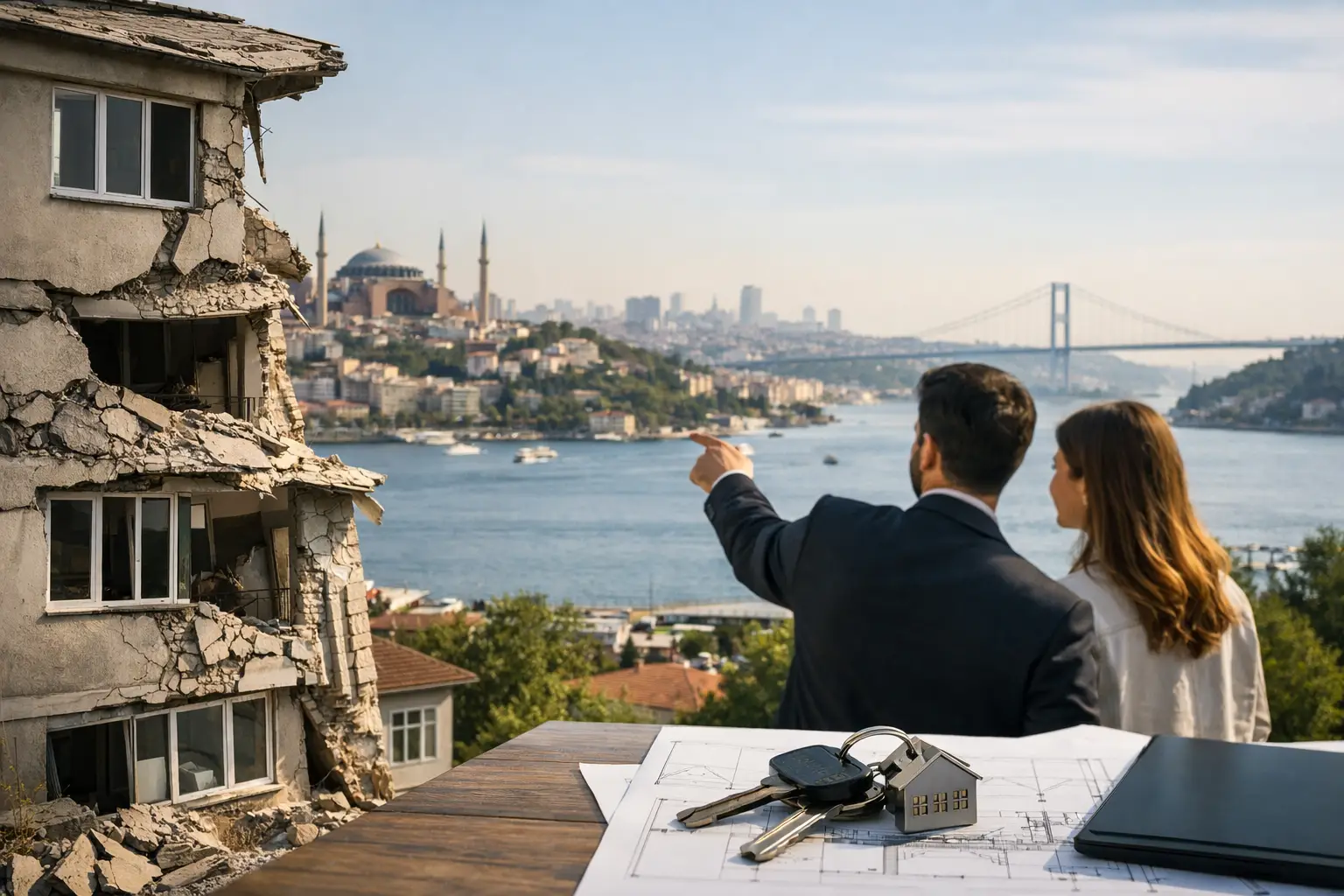
Be especially cautious with properties that have undergone major alterations. Removing walls, enclosing balconies, adding unauthorized floors, or changing the use of commercial space can affect a building’s performance. In a resale property, compare the current layout with approved plans when possible. What appears to be a convenient renovation may have introduced a risk that is not obvious during a viewing.
Request Documents That Can Be Verified
A confident seller or developer should be prepared to support key claims with documentation. The exact records available will differ by building age and property type, but a serious review commonly includes permits, the occupancy permit, title deed details, approved project plans, and available ground or engineering reports.
For an apartment in a professionally managed residence, ask the management office about regular maintenance, structural modifications, emergency planning, elevator inspections, fire systems, and insurance. High-quality management does not replace structural design, but it is a positive signal. It suggests that common areas, mechanical systems, and safety procedures receive ongoing attention.
For older buildings, a recent risk assessment can be particularly valuable. Turkey has urban transformation processes designed to identify and renew buildings considered structurally unsafe. If a building has been evaluated, ask for the result and understand its scope. A basic risk determination is not necessarily the same as a comprehensive performance analysis by an independent structural engineer.
Documents should be translated or explained clearly enough for the buyer to understand what they show. International purchasers should not feel pressured to accept a verbal assurance when a technical or legal question remains unanswered. A reliable advisor can coordinate the right questions, organize the document review, and identify when independent professional input is appropriate.
Use an Independent Expert for Higher-Value Decisions
For a high-value villa, an older resale apartment, a commercial building, or a property intended for a long-term family move, hiring an independent civil or structural engineer can be a prudent part of due diligence. The engineer can review accessible documentation, inspect visible conditions, and advise whether more detailed testing or analysis is warranted.
This is not a promise that any property is earthquake-proof. No building can be guaranteed against every possible event. The purpose is to reduce uncertainty, identify warning signs, and make a decision based on professional evidence rather than marketing language.
An on-site review is especially worthwhile if you notice diagonal cracks, signs of settlement, exposed reinforcement, water intrusion around structural areas, poorly executed additions, or significant differences between units. Some cracks are cosmetic, while others may point to movement or deterioration. Buyers should not try to diagnose them alone.
The trade-off is straightforward: technical due diligence adds time and cost before purchase. For an asset intended to preserve wealth, produce income, support citizenship by investment, or become a family home, that cost is often small compared with the consequences of a poorly assessed acquisition.
Consider Insurance, Emergency Access, and Daily Resilience
Earthquake risk is also about what happens after shaking stops. Confirm whether compulsory earthquake insurance, known as DASK, is in place or can be arranged, and understand its coverage limits. DASK can be an essential foundation, but it may not cover every loss or every element of a higher-value property. Additional insurance may be appropriate depending on the property type, furnishings, and investment strategy.
Look beyond the building entrance as well. Consider road access for emergency services, proximity to open assembly areas, the reliability of water and power infrastructure, and the quality of building management. In a high-rise residence, ask about backup power, emergency communication, stairwell conditions, and evacuation procedures. These details influence both practical safety and tenant confidence.
For investment buyers, resilience increasingly supports marketability. Tenants and resale buyers are more likely to ask about construction quality, permits, insurance, and building age. A well-documented property in a reputable development can therefore offer an advantage beyond peace of mind.
Put Risk Into the Full Investment Decision
Earthquake due diligence should sit alongside title deed checks, valuation, rental analysis, location strategy, and eligibility requirements for any citizenship application. A property can be beautifully located and financially attractive, yet still be the wrong choice if its documentation is unclear or its building condition cannot be explained with confidence.
The strongest opportunities are rarely selected by one factor alone. They combine a location that matches your lifestyle or tenant market, a price that makes commercial sense, and a building supported by credible technical and legal records. At Hayat, buyers can use local market guidance to compare projects and resale options with a clearer view of both opportunity and responsibility.
A thoughtful buyer does not need perfect certainty before purchasing in Istanbul. They need the right questions, the right documents, and the discipline to pause when answers are incomplete. That is how an exciting property decision becomes a more secure long-term investment.