
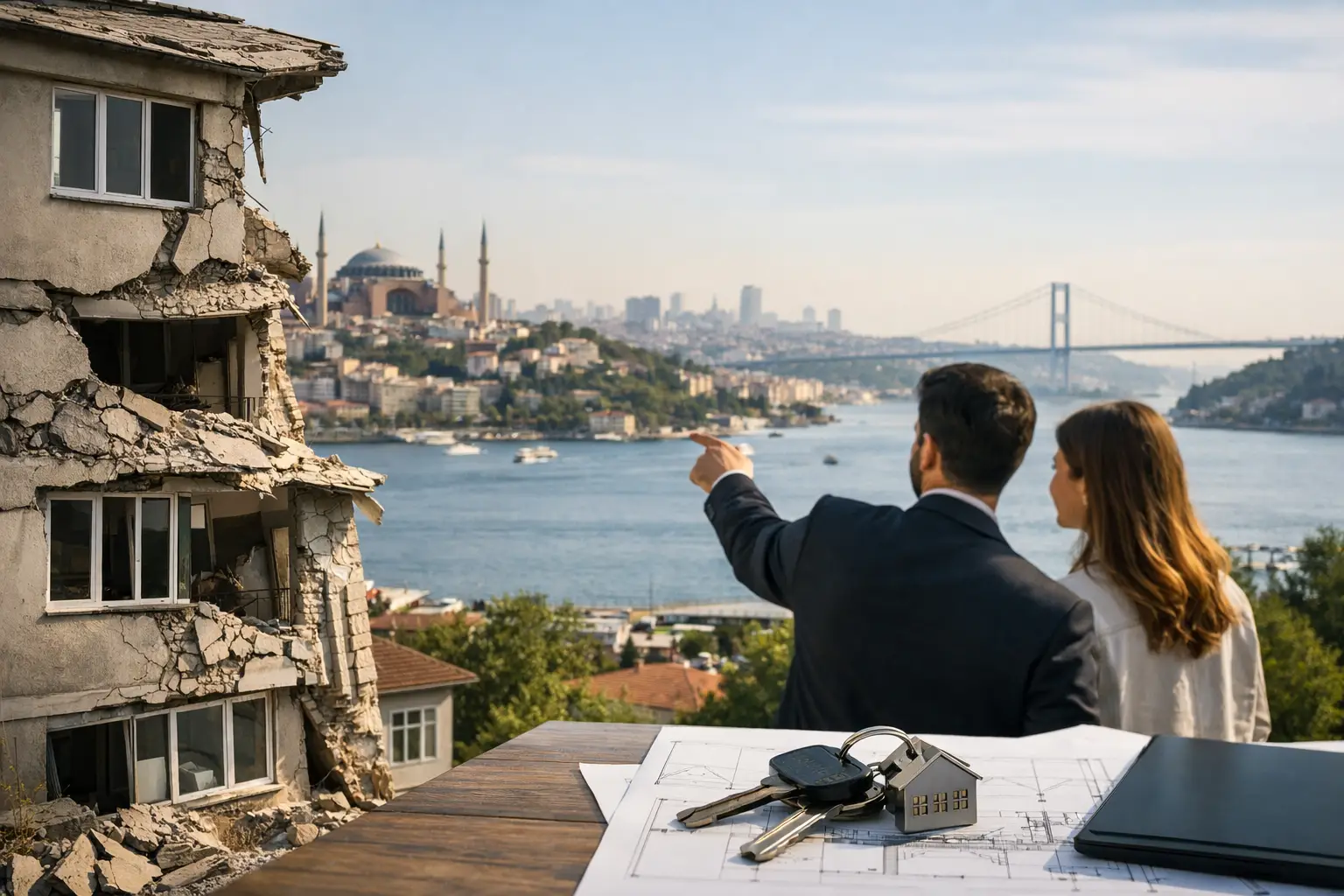
A sea view, a new residence lobby, and a strong rental projection can make an Istanbul property feel like an obvious choice. Yet for an international buyer, the building itself deserves the same scrutiny as the location and price. This Istanbul earthquake risk property guide explains how to assess a home or investment property with practical questions, documentary checks, and realistic expectations.
Istanbul sits in a seismically active region. Earthquake risk is therefore not a niche concern or a reason to avoid the market altogether. It is a core part of buying well. The strongest opportunities are often found when buyers look beyond marketing language and evaluate a property’s construction era, technical records, ground conditions, maintenance, and long-term liquidity.
Earthquake risk in Istanbul: what buyers should understand
No consultant, developer, or engineer can promise that a particular building is “earthquake-proof.” That phrase is too absolute. What a careful buyer can assess is whether a property was designed, permitted, built, and maintained to a standard that is more appropriate for its location and age.
Turkey’s building regulations have strengthened substantially over time, with major changes following the 1999 Marmara earthquake and further updates under the Turkish Building Earthquake Code introduced in 2018. As a general rule, a properly documented newer development built under current requirements may offer a stronger starting point than an older building. But construction year alone is not a guarantee. Quality of execution, soil conditions, alterations, and ongoing maintenance all matter.
For buyers comparing a resale apartment in a central historic neighborhood with a newly delivered residence on Istanbul’s outer growth corridors, this creates a genuine trade-off. The older home may offer character, walkability, and established rental demand. The newer project may offer modern structural design, amenities, parking, and clearer technical documentation. The right decision depends on your lifestyle priorities, investment horizon, and appetite for renovation or redevelopment risk.
Start with the building, not the district label
District reputation can be useful for understanding access, lifestyle, and price growth. It cannot establish a building’s safety. Two properties on the same street can have very different construction quality, permits, foundations, and management histories.
Ask first when the building was completed and whether it has an occupancy permit, commonly called an iskan. This document is a meaningful part of the legal and technical picture because it indicates that the completed building was accepted for use. It should not be treated as a standalone structural certificate, but its absence deserves a clear explanation before you proceed.
Then ask whether the project has a building permit, approved architectural and structural plans, and records relating to the building inspection process. In a newer development, the sales team or developer should be able to explain the project’s construction framework clearly. In a resale purchase, documents may be held by the owner, building management, municipality, or relevant professional parties, so the process can take more coordination.
A buyer should also be alert to changes made after completion. Enclosed balconies, removed interior walls, unauthorized rooftop additions, or commercial modifications at street level can affect both compliance and risk. Not every alteration creates a structural problem, but it should never be ignored simply because a unit looks attractive.
Questions worth asking before reserving a property
Before paying a reservation fee or signing a preliminary agreement, request direct answers to these points:
- What year was the building completed, and under which permit process was it constructed?
- Is the occupancy permit available, and does the title deed match the unit being sold?
- Can the seller provide approved project plans and relevant inspection records?
- Has the building undergone a structural assessment, urban transformation process, or major renovation?
- Have there been visible cracks, water intrusion, foundation concerns, or disputes involving the building?
- What is the condition of the shared areas, including parking levels, retaining walls, elevators, and emergency systems?
Clear documentation and consistent answers are positive signals. Delays, contradictions, or pressure to proceed without review should lead to further investigation, not a faster decision.
Understand ground conditions and micro-location
A building’s response in an earthquake is influenced not only by its structure but also by the ground beneath it. Istanbul includes coastal areas, former filled land, sloped zones, and neighborhoods with varying soil profiles. This is why broad statements such as “the European side is safer” or “this district has no risk” are unreliable.
For a serious purchase, ask about the project’s geotechnical or soil survey. New developments typically conduct this work as part of the design and permitting process. The records can help explain the foundation approach and the site conditions considered by the engineers. A qualified local engineer can provide a more informed interpretation where needed.
Location still matters in practical ways. Consider access routes after an emergency, proximity to open gathering areas, the reliability of utilities, and whether the building has backup systems. A luxury tower with generators, water storage, professional security, and organized management may provide greater day-to-day resilience than a similarly priced apartment in a poorly maintained building. These features do not replace structural due diligence, but they shape how a property performs during disruption.
New build, resale, or urban transformation property?
Each category can suit a different buyer profile. A newly built residence often appeals to overseas investors because documentation is usually more accessible, payment plans may be available, and the project can offer a managed lifestyle. It may also be easier to rent to corporate tenants or international families seeking parking, security, and amenities.
A resale apartment can provide stronger value per square foot in established locations, particularly if the owner needs a quick sale. However, the buyer should allow more time for title deed review, building records, maintenance history, and an on-site inspection. Lower acquisition cost should not become a false economy if the building requires extensive future work.
Urban transformation projects can be compelling because they replace aging stock with newly constructed homes. They also require careful review. Confirm the developer’s track record, delivery timetable, land share arrangements, title status, and the exact specifications promised in the contract. A project marketed as “under transformation” is not the same as a completed, documented residence ready for handover.
Protect the investment through legal and financial checks
Earthquake due diligence should sit inside a wider purchase process. The title deed must be checked for ownership, annotations, mortgages, restrictions, and the correct property type. For buyers pursuing Turkish citizenship by investment, the valuation report, payment trail, title deed process, and citizenship eligibility requirements must also be handled with precision. A structurally appealing property is not automatically a qualifying citizenship asset, and a qualifying asset is not automatically the best choice for your portfolio.
Insurance is another practical consideration. Compulsory earthquake insurance, known as DASK, is generally required for residential properties and should be active at transfer. Buyers should understand its coverage limits and consider whether additional home or contents insurance is appropriate, especially for furnished residences, villas, or higher-value assets.
Do not base your decision on a brochure’s projected rental return alone. Properties with transparent documentation, professional management, and a well-regarded building profile are often easier to resell and lease. In uncertain market conditions, buyer confidence becomes part of the asset’s value.
Build the right professional team
International buyers should not rely solely on a seller’s representative for technical and legal reassurance. A local real estate advisor can shortlist suitable projects and coordinate the purchase journey, but independent legal review and, where the property warrants it, an engineer’s assessment add important protection.
Hayat can help buyers compare Istanbul opportunities by location, property type, investment objective, and citizenship pathway while coordinating the questions that need answers before contract signing. The best advisory process does not rush clients toward the first available unit. It helps them separate a beautiful property from a defensible purchase.
Give yourself permission to walk away if the documents are incomplete, the explanations are vague, or the seller discourages independent checks. Istanbul remains one of the world’s most dynamic property markets, and well-chosen homes can combine lifestyle, rental potential, and long-term strategic value. The opportunity is strongest when confidence is built on evidence, not optimism.