
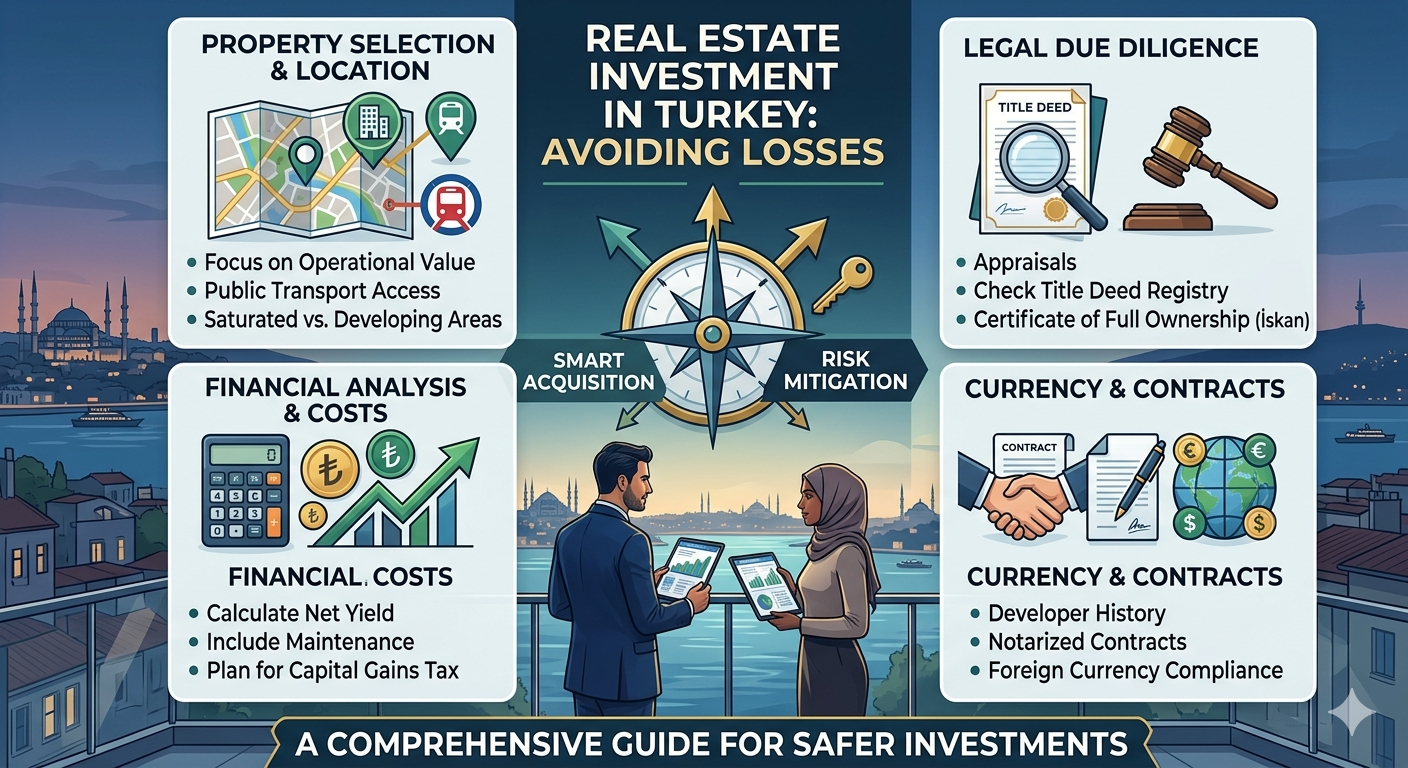

buying property in Turkey: How to Avoid Losses and Risks?
buying property in Turkey: For many foreign investors, buying property in Turkey looks straightforward from the outside.
You find a project, compare prices, choose a location, sign paperwork, and become a property owner.
But once you start speaking with investors who have already entered the market, a different picture appears.
Some investors achieved strong returns and built profitable portfolios.
And this is exactly why understanding how to reduce risk before purchasing has become more important than ever.
Why Do Foreign Investors Lose Money in Property Investments?
When analyzing unsuccessful property investments, several patterns appear repeatedly.
Some investors purchased properties in weak locations.
Others focused only on low prices.
Some bought properties that were legally unsuitable for their investment goals.
And many simply rushed into purchases without properly understanding how the Turkish property market actually works.
In many cases, the market itself was not the problem.
The problem was the buying strategy.
Do Not Let Cheap Prices Make the Decision for You
One of the most common mistakes among first-time buyers is assuming that cheaper properties automatically mean better investment opportunities.
In reality, lower prices often exist for reasons.
A property may be cheap because of:
- weak transportation access,
- limited demand,
- construction quality problems,
- poor resale potential,
- legal complications,
- or unattractive locations.
- A slightly more expensive property located in a stronger area often performs better over time.
The better question is not:
“How cheap is this property?”
Instead ask:
“Why is this property priced this way?”
Location Still Determines Most of the Investment Outcome
Regardless of market conditions, location remains one of the strongest factors affecting property performance.
Properties located near:
- metro lines,
- universities,
- business districts,
- shopping centers,
- hospitals,
- and transportation hubs
usually maintain stronger demand.
Many investors spend too much time analyzing the apartment itself while ignoring what surrounds it.
But the surrounding area often determines future performance more than the building itself.
Define Your Goal Before Looking at Projects
One expensive mistake is beginning the property search without knowing exactly why you are buying.
Ask yourself:
- Are you buying for rental income or Turkish citizenship?
- Or are you after resale profit,
- family relocation,
- or long-term wealth preservation?
Different goals require completely different strategies.
The property that is suitable for citizenship purposes may not necessarily be the best one in terms of rental returns. Similarly, a family apartment may not perform well as an investment asset.
Clear objectives reduce unnecessary risk.
Never Depend Entirely on Marketing Promises
Real estate advertisements often promise guaranteed rental returns, fast price appreciation, limited opportunities, or exceptional investment performance.
But real market conditions are rarely that simple. Before purchasing, study actual property prices, average rental income, competition levels, local demand, and infrastructure growth.
Historical price trends
Buying based on data usually produces better results than buying based on sales presentations.
Research the Developer Carefully
In off-plan and newly developed projects, the developer becomes extremely important.
Before purchasing, ask questions such as:
How many projects has the developer completed?
Were previous projects delivered on time?
What do previous buyers say?
Does the company have legal disputes?
Is construction quality consistent?
A strong developer reduces many future risks.
A weak developer can turn a good-looking project into a costly mistake.
Calculate the Real Cost — Not Only the Purchase Price
Many investors calculate only the property price itself.
However, actual ownership costs may include:
taxes,
title deed expenses,
furnishing costs,
maintenance fees,
monthly residential complex charges,
legal fees,
renovation expenses.
Ignoring these costs creates unrealistic profit expectations.
The total investment matters more than the advertised price.
Study Rental Returns Realistically
If rental income is your goal, understanding real demand becomes essential.
Do not rely only on projected numbers.
Instead examine:
current rental prices,
occupancy rates,
tenant demand,
competition nearby,
maintenance expenses.
Real rental returns are often different from marketing estimates.
Investors who understand actual market conditions usually make better decisions.
Understand Legal Requirements Before Buying
Some investors discover problems only after purchasing.
Examples include:
properties unsuitable for citizenship applications,
residency-restricted districts,
valuation problems,
incomplete title deed documentation.
These problems are often avoidable.
This is why legal verification should be considered part of the investment process rather than an optional extra step.
Avoid Making Decisions Under Pressure
Property buyers frequently hear phrases like:
“Last unit available.”
“Prices will increase tomorrow.”
“This opportunity will disappear.”
Urgency is often part of sales strategy.
Property investment, however, is usually a long-term decision.
Comparing several projects and taking time to evaluate options often reduces costly mistakes.
Buying quickly does not always mean buying smart.
Think About Selling Before You Buy
Many investors focus entirely on purchasing.
Fewer think about exiting.
Before buying, ask:
Can this property be resold easily?
Will future demand remain strong?
Is the location liquid?
Is the property type popular?
Good investments are not only easy to buy.
They should also be reasonably easy to sell.
Common Mistakes Foreign Buyers Continue to Make
Several mistakes appear repeatedly across the market:
buying emotionally,
focusing only on price,
ignoring transportation access,
failing to compare projects,
overlooking legal requirements,
underestimating ownership costs,
skipping market research.
Individually, these mistakes may appear small.
Combined, they can significantly reduce investment performance.
Is Property Investment in Turkey Still Worth It?
Turkey continues to attract investors because the market still offers:
strong domestic demand,
growing infrastructure,
citizenship opportunities,
rental income potential,
and relatively diverse investment options.
But the market has changed.
Success today requires more research than it did years ago.
Buying almost any property and expecting strong returns is becoming less reliable.
Careful selection matters more.
Final Thoughts: buying property in Turkey
buying property in Turkey: Avoiding losses when buying property in Turkey is not about predicting the market perfectly.
It is usually about reducing avoidable mistakes.
Successful investors typically focus on:
choosing the right location,
understanding their objectives,
researching the market carefully,
checking the legal details,
figuring out real ownership costs,
vetting developers properly,
and planning a long-term exit strategy.
In most cases, loss avoidance has more to do with finding the right property than it does with finding the cheapest one.
In a competitive market like Turkey, that difference matters more than ever.
In a crowded market, like Turkey’s, that edge matters even more now.
In Turkey’s tough market, that gap can matter a lot right now.
In a tough market such as Turkey, that difference counts more than ever.
In Turkey, where competition is fierce, that edge matters big time.
read more: